
5 Features of Excellent Hotel Internet for Guests: A Practical Guide
How does a commercial hotel network differ from a standard residential internet setup? Hotel guests demand high-speed, hyper-reliable wireless connections that support frictionless remote work, 4K streaming, and multi-device synchronization.
How does a commercial hotel network differ from a standard residential internet setup? Hotel guests demand high-speed, hyper-reliable wireless connections that support frictionless remote work, 4K streaming, and multi-device synchronization without local dropouts.
In today’s hyper-connected landscape, providing seamless internet access in a hotel has evolved from a premium luxury into an absolute infrastructure baseline. Guests expect zero-friction wireless performance everywhere — from their guest rooms and local restaurants to conference spaces, spas, and pool decks.
A well-architected hospitality Wi-Fi ecosystem represents a key driver of guest satisfaction scores and a core competitive advantage. Below are the five defining traits of high-performing hotel internet connectivity.

1. High-Speed, High-Throughput Stability
When evaluating hotel internet networks, raw bandwidth and runtime stability are paramount. With the massive growth of remote work, corporate travelers expect stable throughput metrics to seamlessly run intensive video conferences, access remote cloud infrastructure, or unwind with ultra-HD video streaming after a business day.
Investing in next-generation enterprise hardware ensures symmetrical speed distribution and solid signals across every square meter of the property, regardless of architectural layout or masonry thickness.
2. Frictionless Onboarding and Intuitive Captive Portals
Guest network authentication must be completely seamless. Overly complex login workflows that demand repetitive credential inputs, cumbersome registration forms, or prolonged SMS verification codes frustrate guests during onboarding.
The ideal architecture employs a smart captive portal allowing single-authentication access that securely retains the device connection for the entire duration of the guest’s stay. High-performing hotels segment these structures further, offering dedicated premium bandwidth packages for business executives, event attendees, or digital nomads.
3. Enterprise-Grade Security and Compliance
Data privacy is a foundational challenge of the digital age. Hotel guests expect that their shared wireless data traffic remains completely secure from external snooping.
True hospitality integrators engineer multi-layered security frameworks, utilizing advanced enterprise firewalls, isolated virtual networks (VLAN segmentation), and continuous automated system updates. This prevents cross-device intrusion on the public network, keeping guest credentials, banking connections, and corporate data fully protected.
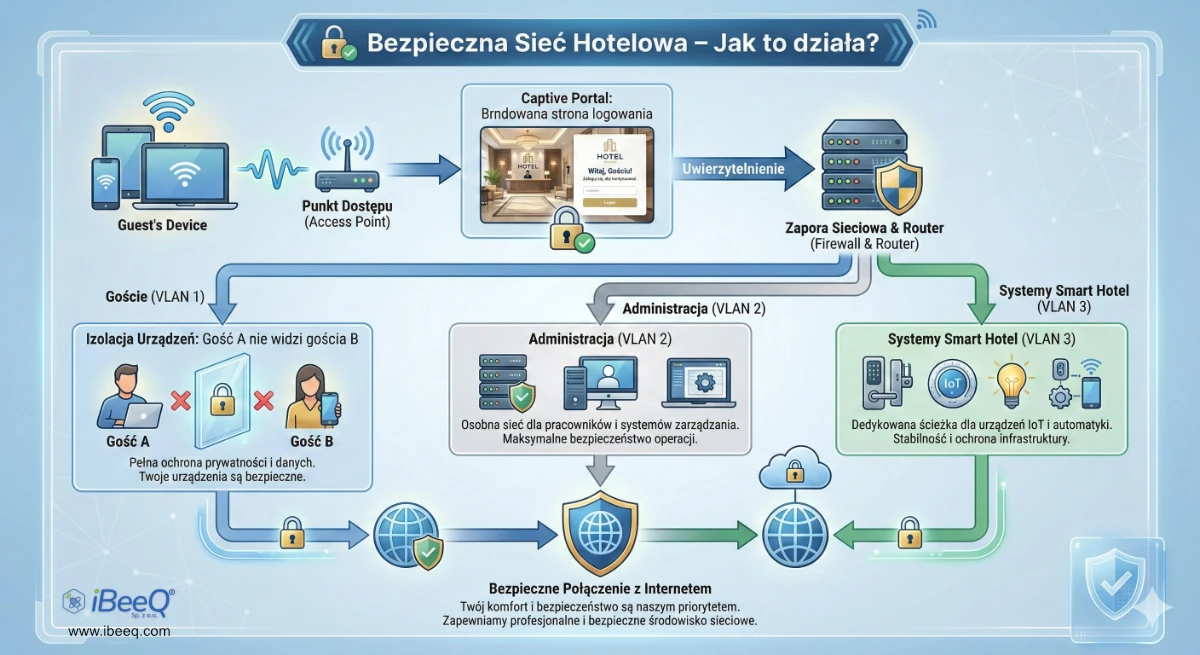
Technical Architecture Overview: Residential vs. Hotel Wi-Fi
| Operational Capability | Standard Residential Setup | Enterprise Hotel Wi-Fi Ecosystem |
|---|---|---|
| Concurrent Device Handling | Optimized for 10–15 local family devices. | Engineered for hundreds of concurrent multi-user devices scaling dynamically. |
| Network Security Model | Simple shared WPA2/WPA3 pre-shared password key. | Granular VLAN segmentation, isolated client access, and enterprise firewalls. |
| Coverage Management | Single router with basic range extenders. | Scaled grid of cloud-managed Access Points with seamless roaming (802.11r/k/v). |
| Traffic Engineering | Flat traffic path; first-come, first-served bandwidth. | Active Quality of Service (QoS) prioritizing critical hospitality, VoIP, and video data. |
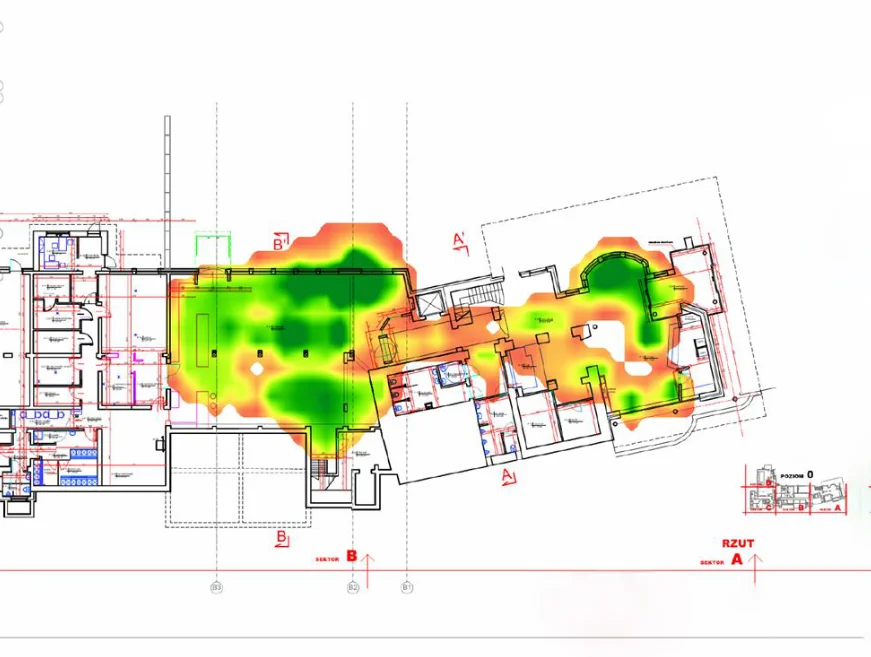
4. Omnipresent Property Coverage
Few guest experiences generate negative reviews faster than wireless dead zones inside a property. A highly resilient hotel network guarantees comprehensive coverage across every zone:
- Guest rooms and suites (including balcony spaces)
- Fine-dining restaurants and common breakfast lounges
- Conference rooms, boardrooms, and event spaces
- Recreational zones, gyms, spas, and outdoor pools
Ensuring complete property saturation safeguards guest experience metrics and underpins key internal digital services, such as mobile housekeeping tools and smart access lock synchronizations.
5. Proactive Engineering and Specialized Support Teams
Even the most robustly engineered network topologies can encounter unexpected structural challenges. When a node encounters a glitch, immediate remote remediation and professional tech support are critical to minimize guest friction.
Choosing a general IT service provider unfamiliar with the specific constraints of the hospitality sector often yields poor results. Hotel properties feature unique architectural obstacles, fluctuating peak user loads, and mission-critical PMS integrations that require a specialized hospitality network integrator.
FAQ — Frequently Asked Questions
Why does a hotel network slow down significantly between 8 PM and 11 PM?
This bottleneck represents the classic “hospitality peak-load surge.” During these hours, hundreds of concurrent guests return to their rooms and simultaneously activate multiple streaming devices, casting interfaces, or video calls. While a residential router would freeze under this pressure, an enterprise hotel network utilizes Quality of Service (QoS) configurations to throttle individual consumption limits evenly, preserving stable speeds for all users.
Is a password-protected hotel network completely safe without additional tools?
Not automatically. A shared password across an unsegmented network still allows devices to theoretically see other traffic sharing that medium. To prevent this, enterprise hotel networks enforce Client Isolation within the guest VLAN, ensuring that even though guests connect to the same SSID, their devices cannot discover or access each other.
What is the advantage of using a dedicated network integrator like iBeeQ?
General IT providers deploy systems matching a basic office environment. A hospitality specialist like iBeeQ maps out complex concrete wall attenuation values, configures dedicated billing/PMS APIs, implements secure automated captive portals, and provides proactive 24/7 network monitoring to resolve hardware anomalies before guests even notice a drop.
iBeeQ designs and deploys enterprise hotel Wi-Fi networks across Europe — including network audits, captive portal integration, VLAN segmentation, and proactive 24/7 monitoring. Contact us for a free technical consultation.
Planning a hotel technology upgrade?
Our engineers have implemented hotel TV and WiFi systems across hundreds of properties in Europe. Let's talk about your project.
Contact us