
WiFi 7 in Hotels: What It Means for Your Guests and How to Deploy Next-Gen Networks
A comprehensive guide for hoteliers on WiFi 7 (802.11be) — how it compares to WiFi 6, when to invest, and how iBeeQ designs high-density hotel networks.
A comprehensive guide for hoteliers who want to stay ahead of the competition using the IEEE 802.11be standard.
Hotel guests never forgive poor internet. Industry studies consistently show that the quality of a WiFi connection ranks among the top three factors influencing guest satisfaction scores — right alongside room cleanliness and bed quality. In an era dominated by remote work, 4K streaming, and seamless video conferencing directly from guest rooms, wireless networking is no longer an amenity. It has evolved into critical business infrastructure.
The WiFi 7 (IEEE 802.11be) standard represents the enterprise response to the connectivity demands of 2026 and beyond. In this article, we break down exactly what WiFi 7 is, how it sets itself apart from prior generations, why a hospitality deployment requires a professional, measured approach, and how iBeeQ helps hoteliers construct high-density networks that truly deliver.
1. A Brief History of WiFi: From 802.11a to 802.11be
The WiFi standard has continuously evolved over the past two decades. Each subsequent generation has brought higher throughput, superior multi-device handling, and reduced latency.
| Generation | Standard | Year | Frequency Bands | Max Theoretical Throughput |
|---|---|---|---|---|
| WiFi 4 | 802.11n | 2009 | 2.4 / 5 GHz | 600 Mbps |
| WiFi 5 | 802.11ac | 2013 | 5 GHz | 3.5 Gbps |
| WiFi 6 | 802.11ax | 2019 | 2.4 / 5 GHz | 9.6 Gbps |
| WiFi 6E | 802.11ax | 2021 | 2.4 / 5 / 6 GHz | 9.6 Gbps |
| WiFi 7 | 802.11be | 2024 | 2.4 / 5 / 6 GHz | 46 Gbps |
| WiFi 8 | 802.11bn | ~2028 | Multi-band | >100 Gbps (Projected) |
For hoteliers, real-world value is not found in lab-tested spec sheets. It is defined by the actual guest experience in room 312 — fighting thick concrete walls, co-channel interference from an access point in room 310, and five active devices connected simultaneously.
2. WiFi 5, WiFi 6, and WiFi 6E: Do They Still Suffice?
WiFi 5 (802.11ac) — The Aging Standard
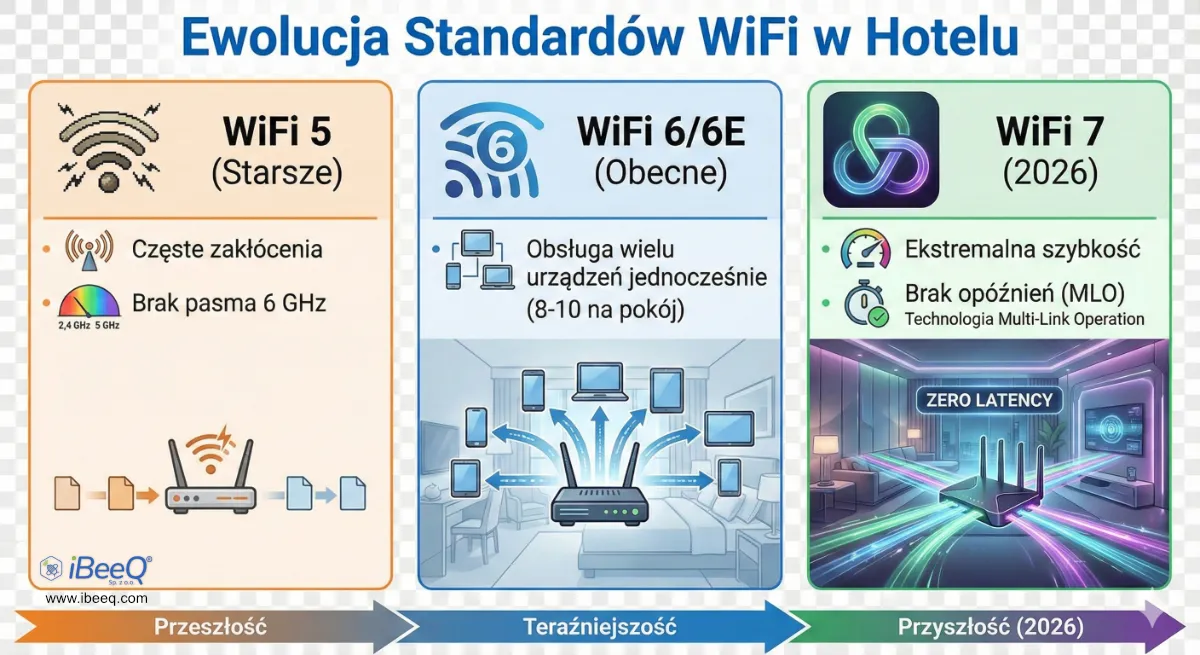
While common in legacy deployments, WiFi 5 operates strictly in the 5 GHz band and lacks advanced multi-user scheduling (OFDMA). Under modern loads — where 30+ devices try to stream or video-call from a single Access Point (AP) — WiFi 5 introduces extreme latency. For new properties or upcoming upgrades, WiFi 5 is no longer a viable long-term investment.
WiFi 6 (802.11ax) — The Multi-Device Breakthrough
WiFi 6 introduced OFDMA (Orthogonal Frequency Division Multiple Access) and BSS Coloring, allowing multiple devices to talk simultaneously on the same channel without blocking each other. It includes WPA3 security and Target Wake Time (TWT) for smart room IoT devices. Today, WiFi 6 is the absolute baseline for any modern property deployment.
WiFi 6E — Entering the 6 GHz Airwaves
WiFi 6E expanded on WiFi 6 by opening the clean, interference-free 6 GHz spectrum. It offers extra wide channels but introduces a major hospitality hurdle: the 6 GHz frequency has a shorter propagation range and struggles to penetrate dense hotel walls, requiring precise AP placement based on RF heatmaps.
3. WiFi 7: The True Enterprise Game-Changer
WiFi 7 (IEEE 802.11be) goes far beyond just raw speed upgrades. It alters how wireless data behaves under extreme high-density conditions:
- Multi-Link Operation (MLO): Legacy devices can only connect to one band at a time (e.g., either 5 GHz or 6 GHz). WiFi 7 devices connect to multiple bands simultaneously. If one frequency encounters interference, traffic instantly shifts to another, dropping latency below 1 ms.
- 320 MHz Channels: WiFi 7 doubles the maximum channel width of WiFi 6 from 160 MHz to 320 MHz, creating massive data expressways.
- 4096-QAM Modulation: Enhances data density by 20% compared to WiFi 6’s 1024-QAM, squeezing more data into the same radio wave.
- Preamble Puncturing: Instead of blocking an entire wide channel when interference is detected on a small slice, WiFi 7 “punctures” and bypasses only the blocked segment, utilizing the rest of the frequency efficiently.
4. When Should a Hotel Invest in WiFi 7?
It is highly recommended if:
- You are building a new property or executing a top-to-bottom structural renovation.
- Your current network hardware is over 5 years old and running on WiFi 5 or older legacy configurations.
- You actively receive guest complaints about internet dropping or buffering during peak hours (8 PM – 11 PM).
- You plan to roll out next-generation interactive IPTV systems or extensive IoT Smart Room automations.
- Your property features heavy conference and event spaces hosting hundreds of concurrent users.
You can temporarily wait if:
- A professional, enterprise-grade WiFi 6 or WiFi 6E network was deployed within the last 2 to 3 years by a certified integrator utilizing proper RF site surveys. The network currently operates smoothly, and guest feedback is positive. Even so, future-proof your upcoming switches and PoE cabling to be ready for an easy AP swap down the line.
5. FAQ — Frequently Asked Questions
What is the practical difference between WiFi 7 and WiFi 6 in a hotel?
WiFi 7 introduces Multi-Link Operation (MLO), which allows a single device to transmit and receive data across multiple radio bands simultaneously. Combined with 320 MHz channels and Preamble Puncturing, it completely eliminates typical hotel congestion slowness and minimizes latency, even when hundreds of guests log on at the same time.
How many WiFi 7 Access Points does a 50-room hotel require?
The required number of access points depends strictly on the building’s architectural layout, wall thickness, and materials — not on the WiFi standard itself. A typical 50-room hotel requires between 5 to 10 strategically placed enterprise APs. WiFi 7 doesn’t necessarily change the physical count, but it drastically increases the capacity and performance of each individual AP in high-density areas like lobbies, restaurants, and conference rooms.
Should we wait to invest directly in WiFi 8?
No. The WiFi 8 (802.11bn) standard is currently in early development stages by the IEEE. Full ratifications and stable hospitality enterprise hardware are not expected to hit the market until 2029–2030. Upgrading to WiFi 7 today ensures a highly modern, top-performing network infrastructure that will easily remain competitive for the next 6 to 8 years.
Why are professional RF site surveys essential before installation?
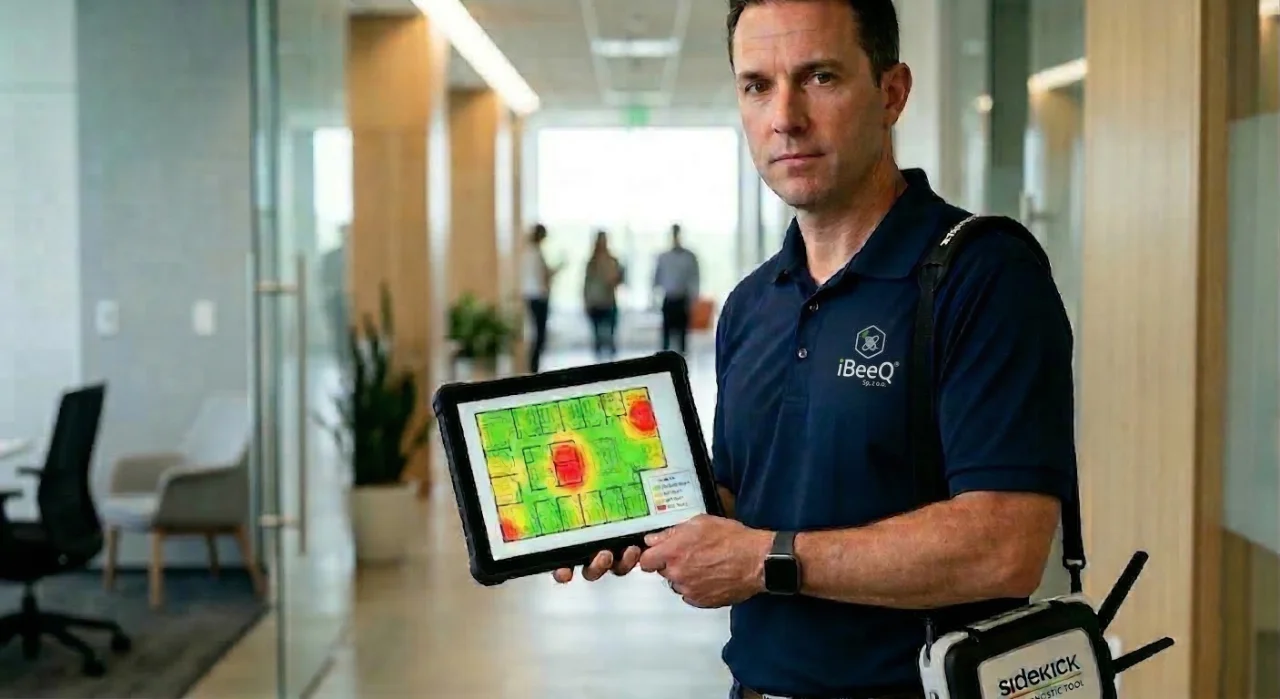
Wireless signals drop significantly depending on concrete walls, metal structural beams, elevator shafts, and external interference. Without an engineering-grade RF heatmap (utilizing industry-standard tools like Ekahau Pro), deploying a network is pure guesswork. Professional site surveys ensure you do not under-provision (causing dead zones) or over-provision (wasting budget and creating self-interference).
What hardware brands does iBeeQ deploy for hotel projects?
We work with top-tier enterprise solutions tailored to the property’s budget and specific technical scaling requirements. This includes Ubiquiti UniFi, TP-Link Omada, Cisco Meraki, Aruba Networks, and Ruckus. Our focus is always on engineering an optimal price-to-performance ratio while considering traffic density, future expandability, and seamless backend management.
iBeeQ designs and installs WiFi networks in hotels across Europe. We begin every project with RF measurements and a thorough requirements analysis — never from a product catalogue. Contact us for a free initial consultation.
Planning a hotel technology upgrade?
Our engineers have implemented hotel TV and WiFi systems across hundreds of properties in Europe. Let's talk about your project.
Contact us