
What Makes a Good Hotel TV? A Practical Buyer's Guide
A hotel TV is not just a screen. The right hospitality television supports Chromecast, Android TV, CMS remote management, and PMS integration — features that protect both the guest experience and your investment.
Fifteen years ago, hotel rooms still had VHS players for in-room entertainment. Today, guests arrive with their own films, music, and streaming subscriptions — on smartphones, at the highest available quality. A hotel television that cannot keep up with these expectations is not a guest amenity; it is a source of friction.
Selecting hotel televisions on brand name alone misses the point. The right hospitality TV is defined by capabilities: what it can do for the guest, how it can be managed across an entire property, and how it will perform five years from now.
Here is what those capabilities actually look like.
Chromecast: The Standard for Secure In-Room Streaming
The most common request from guests in the past several years has been straightforward: access to their personal streaming accounts on the room TV. Technologies like Miracast, Screen Mirroring, and Wi-Fi Direct work well in home environments but create problems in hotel rooms — not every device supports them, pairing is inconsistent, and none of them handle the fundamental security challenge: guests must never enter their streaming credentials into a shared television.
Google Chromecast solves this. Compatible with Android, iOS, and Windows laptops, Chromecast allows guests to cast from their personal device to the room TV without entering any credentials on the television itself. All authentication data stays on the guest’s device. After checkout, the pairing session is automatically cleared.
Chromecast currently supports over 2,000 applications — Netflix, YouTube, Spotify, Disney+, HBO Max, Amazon Prime, and hundreds of regional and linear TV apps. No Smart TV ecosystem comes close to this breadth.
For hotel deployment, Chromecast implemented as a separate dongle (plugged into the HDMI port) creates risks — dongles are easy to steal and require additional management software with associated licensing costs. The better solution is a hospitality TV with Chromecast built into the mainboard, where the cast engine is hardware-enclosed and managed as part of the television itself.
Android TV: Apps, Updates, and Long-Term Value
For guests who want more than casting, televisions running a managed Android platform provide access to the full Google Play ecosystem. A property can install any application from the store — or curate specific app bundles for different guest profiles. A family segment might receive children’s content applications; a business travel floor might get productivity and news apps specific to a particular region.
The more strategically important benefit is longevity. Consumer television firmware typically stops receiving updates when a model is discontinued. Without software updates, a television’s ecosystem ages rapidly — apps break, security vulnerabilities accumulate, and the guest experience degrades. Android TV hospitality platforms carry guaranteed update commitments, ensuring that televisions purchased today will continue supporting current streaming applications and security standards several years from now. This directly extends the hardware investment cycle.
Content Management: Control Every Screen Remotely
A property with fifty rooms cannot afford to update each television individually. Reprogramming televisions room by room — subject to Do Not Disturb signs, occupied rooms, and varying model configurations — can consume an entire working day, or more. For routine channel list updates or welcome screen changes, this is unsustainable.
Modern hospitality televisions include a software-based content management system (CMS) at no extra cost. The platform runs on a standard Windows computer (no dedicated server required) and communicates with each television over the hotel’s LAN or Wi-Fi network. From a single dashboard, staff can:
- Push channel list updates to all rooms simultaneously
- Change welcome screens, brand graphics, and promotional content
- Display weather, dining specials, spa offers, and event schedules
- Lock and manage television settings remotely
- Monitor firmware versions and device status
The WYSIWYG editor in most CMS platforms requires no technical expertise — front desk staff can update content without involving an installer or vendor support call.
HD and 4K: Signal Source Flexibility
Modern hospitality televisions receive and display HD and 4K content regardless of how the signal arrives — DVB cable (coaxial), IPTV over the hotel’s LAN, or streaming from the internet. Better hospitality platforms support both unicast and multicast IPTV streams.
One particularly useful capability: a unified channel list from multiple signal sources. Satellite, terrestrial, IPTV, and internet-sourced channels can be merged into a single, logically ordered list from the guest’s perspective — eliminating the confusing multi-source navigation that consumer televisions present.
Some hospitality TV models include viewership monitoring, tracking which channels are actually watched across the property. This data enables more informed decisions about channel packages — eliminating low-viewership subscriptions and reducing retransmission licensing costs.
PMS Integration: The TV Knows Who Is in the Room
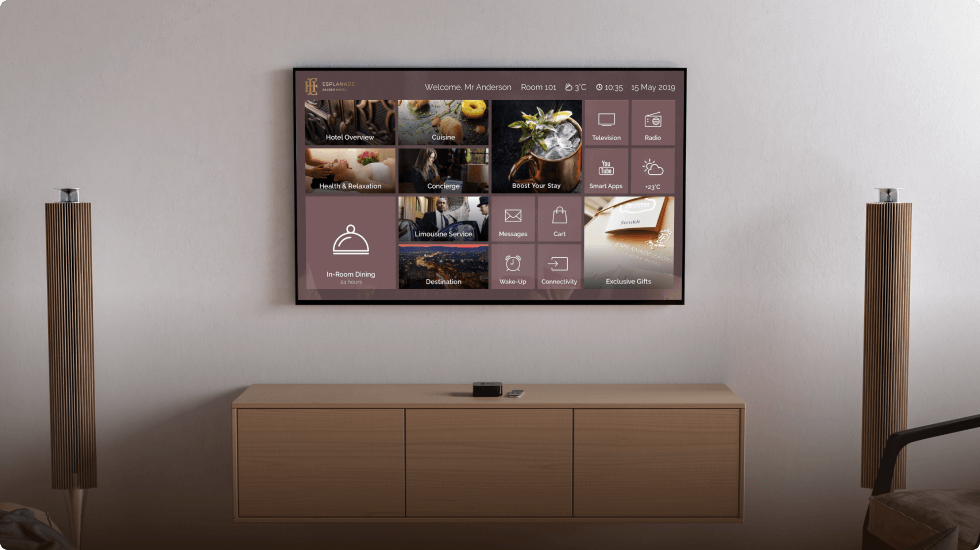
A hotel television connected to the Property Management System (PMS) becomes a personalized guest interface. At check-in, the TV automatically displays the guest’s name and can surface relevant offers based on reservation data. During the stay, guests can review their folio in real time.
Reception staff gain a direct communication channel — messages, notifications, and checkout confirmations can be pushed to the in-room screen without a phone call.
These PMS-connected capabilities — once available only through expensive third-party interactive TV systems — are now standard features of well-configured hospitality TV platforms.
FAQ — Frequently Asked Questions
Does a hotel TV need to have Chromecast?
It is not mandatory, but Chromecast is the most effective solution for allowing guests to securely use their personal streaming services without entering credentials on the television. Hotels without a casting solution consistently receive negative feedback from guests expecting streaming access.
Do Android-based hotel TVs require ongoing updates?
Yes — and that is an advantage. Regular Android updates extend the television’s usable life by years, maintain compatibility with current streaming applications, and address security vulnerabilities. Unlike closed-platform hospitality TVs that stop receiving updates at end of production, Android TVs continue improving after purchase.
How does a hotel TV connect to the PMS?
The television is integrated with the Property Management System via a dedicated interface (typically REST API or vendor-specific protocol). Once connected, the TV displays the guest’s name, loyalty status, and relevant offers automatically at check-in, and clears all personal data when the room is marked vacant.
Do modern hotel TVs support 4K content?
Yes. Current hospitality TVs support HD and 4K regardless of the signal source — DVB terrestrial, satellite, IPTV, or streaming. Resolution support is no longer a differentiating factor; integration capabilities, platform longevity, and management features are the meaningful comparison points.
What is a CMS in the context of hotel TV?
A Content Management System for hotel television is the software platform that controls what guests see on their room screens — welcome messages, channel lists, service menus, and promotional content. Examples include Philips CMND, LG Pro:Centric, Hoteza, and Digiguest.
Why are consumer televisions unsuitable for hotel use?
Consumer televisions lack hotel mode, anti-theft lockdowns, and centralized management. They are not designed for the duty cycle of a hotel environment (continuous operation, frequent guest turnover), and they provide no mechanism for remotely clearing guest data between stays.
iBeeQ supplies, installs, and configures hospitality television systems across Europe — including hardware selection, CMS configuration, and PMS integration. Contact us for a free technical consultation.
Planning a hotel technology upgrade?
Our engineers have implemented hotel TV and WiFi systems across hundreds of properties in Europe. Let's talk about your project.
Contact us