Netflix at the Hotel — Streaming Media vs. Hotel TV
98% of hotel guests have their own Netflix. How should hotels enable streaming without sharing logins or compromising guest data? A practical Chromecast & BYOC guide.
Guests no longer arrive at a hotel expecting to watch whatever happens to be on screen. They travel with their own Netflix profiles, Spotify playlists, and YouTube queues — and they expect to access all of it, seamlessly, on the TV in their room.
For years, hotel entertainment meant a modest channel lineup, occasionally supplemented by a pay-per-view movie catalogue that few guests actually used. That model has been overtaken by a simple reality: streaming services like Netflix, YouTube, and Spotify have displaced traditional scheduled television as the primary source of entertainment for a large share of hotel guests.
Usage data from hotel properties consistently shows that streaming app sessions now rival — and in many demographics exceed — the view time of premium paid TV channels. Access to streaming was once a differentiating feature available only to high-end properties. Today, it is an expectation that applies across all hotel categories.
From BYOD to BYOC: Guests Bring Their Own Content
The shift began with BYOD (Bring Your Own Device) — the trend that forced hotels to install HDMI panels and media hubs so guests could physically connect a laptop to the room TV. As wireless technology matured and smartphones became the universal remote for personal entertainment, the relevant concept evolved into BYOC: Bring Your Own Content.
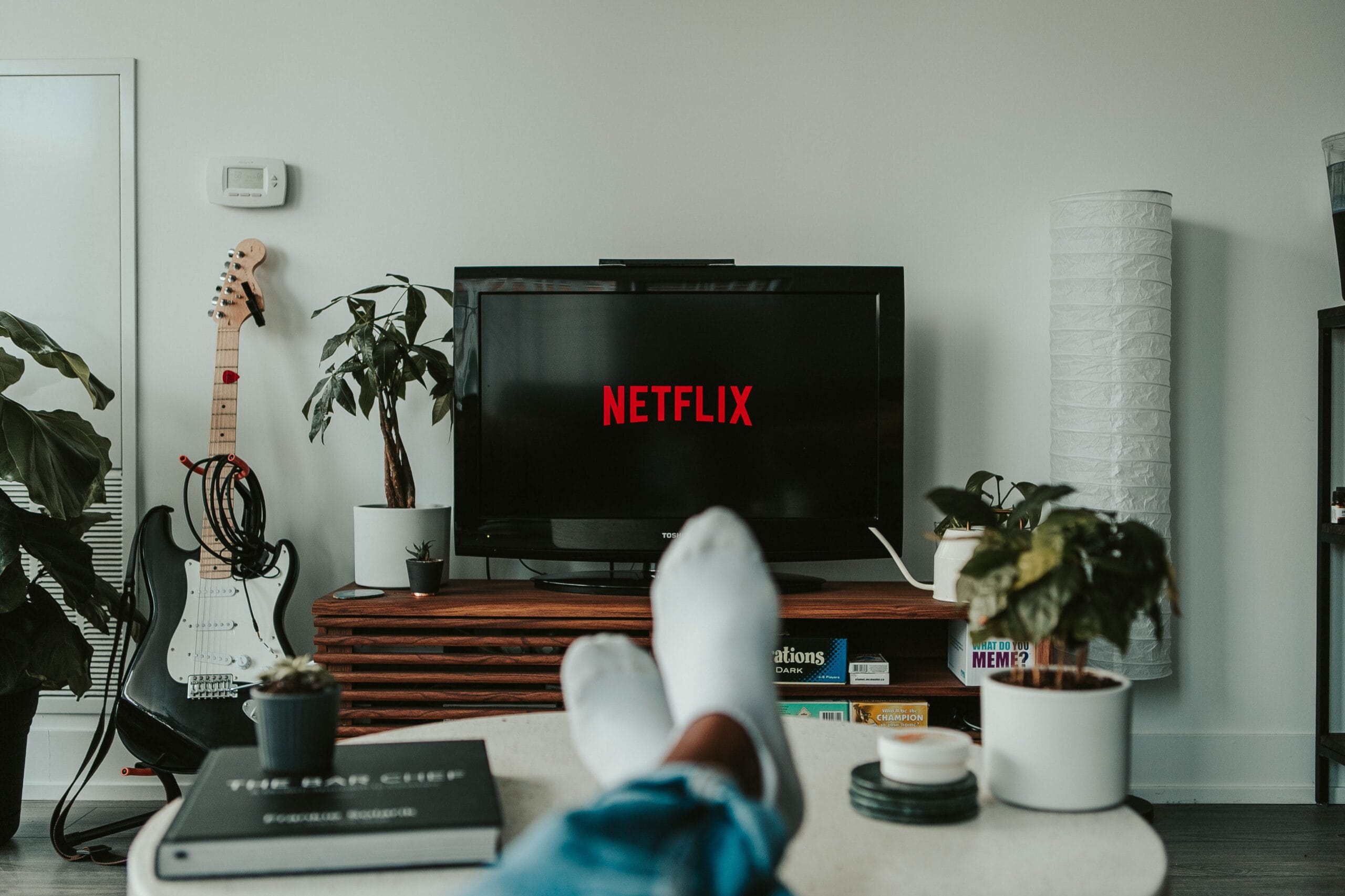
Nearly 98% of hotel guests now travel with a smartphone loaded with streaming subscriptions. They do not want a curated catalogue imposed by the hotel. They want to watch exactly what they watch at home — their Netflix series, their YouTube subscriptions, their Spotify playlist — from their own device, on the largest screen available in the room.
The shift is straightforward for guests. The implementation challenge for hotels is considerable.
Why Smart TVs Are Not the Answer
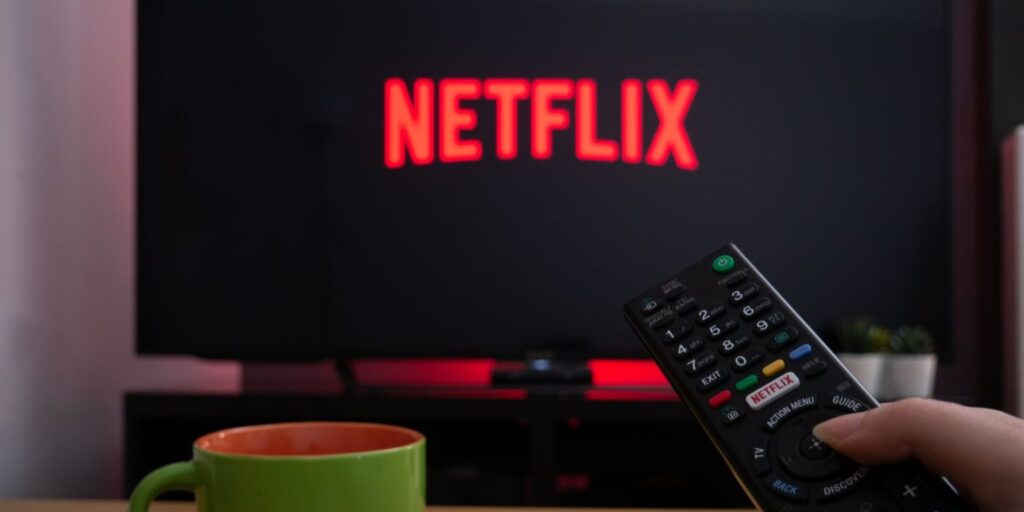
The most frequent guest question in recent years has been: “Does this TV have Netflix?” The instinct of many hoteliers has been to answer it by simply installing consumer Smart TVs. This approach creates a serious security problem that affects guest adoption of the entire in-room entertainment system.
To use Netflix on a standard Smart TV, a guest must type their email address and password directly into the TV interface. Removing those credentials when checking out is a multi-step process that is rarely intuitive — and in practice, most guests either cannot complete it or do not try. The result is that login credentials from previous guests remain stored on the device and are accessible to the next occupant.
The data on guest concern is unambiguous: over 65% of hotel guests report being seriously worried about entering personal credentials into a shared room TV, and a further 30% confirm those concerns. Any in-room entertainment solution that requires credential entry at the TV level will achieve low adoption rates and generate negative reviews regardless of content quality.
Smart TVs carry additional limitations: a restricted app ecosystem compared to personal devices, and apps that frequently stop working as manufacturers discontinue platform updates on older hardware.
Google Chromecast: The Hotel-Grade Solution
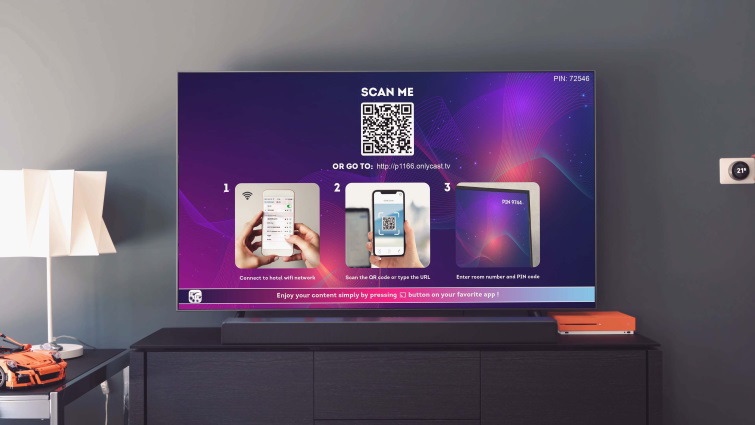
The architecture that solves both the security and usability problems is based on Google Chromecast. Rather than logging into anything on the TV itself, a guest uses the hotel’s Wi-Fi to scan a unique QR code displayed on the room screen. Within seconds, their smartphone is paired with the TV and they can cast any supported app directly to the screen.
How it works — and why it is secure
Chromecast operates differently from screen mirroring technologies. Once a guest initiates a cast session, the TV fetches content directly from the internet. The guest’s phone is only needed to select and control what plays — it does not need to remain unlocked or even screen-on. No credentials are ever typed into the TV. All authentication data lives exclusively on the guest’s personal device.
At checkout, the pairing token is automatically cleared. The next guest scans a fresh QR code and begins their own isolated session.
Key properties for hotel deployment:
- Zero credentials on the TV — full GDPR compliance without manual staff intervention.
- QR code pairing — room-specific codes prevent guests in room 202 from accidentally casting to the screen in room 204.
- 2,000+ compatible apps — Netflix, YouTube, Spotify, Disney+, HBO Max, and hundreds more, including apps that stream linear TV channels the hotel may not carry in its broadcast package.
- Works on any TV with an HDMI input — no requirement to replace existing hardware in a phased rollout.
- Cross-platform — Android, iOS, and Windows 10 laptops all support Chromecast casting natively.
Apple AirPlay in Hotels
For guests on Apple devices, Apple AirPlay provides an equivalent casting experience. A growing number of hospitality-grade TVs — including the Philips MediaSuite 6000/7000 and LG UK-series — integrate AirPlay natively, eliminating external hardware. AirPlay deployments in hotels typically require a gateway component and integration partner configuration to ensure per-room isolation equivalent to Chromecast’s QR pairing model.
Built-In Chromecast on Hospitality TVs
Modern hospitality TV platforms eliminate the need for a separate Chromecast dongle entirely by integrating the casting engine at the mainboard level. Philips MediaSuite and LG Pro:Centric series both offer hardware-enclosed Chromecast as a native feature, simplifying installation, reducing failure points, and enabling tighter integration with property management system (PMS) checkout triggers.
Does Traditional Broadcast TV Still Matter?
Yes. The majority of hotel guests still expect access to linear television — particularly local news, live sports, and regional channels. Streaming and broadcast are complementary, not competing: Chromecast-based BYOC covers the personal content layer, while IPTV or DVB broadcast covers the shared channel lineup.
A well-designed hotel TV system delivers both. The Chromecast/AirPlay layer is additive — it requires no changes to the existing broadcast infrastructure and can be deployed independently at any property scale.
The Management Layer: Keeping 150 Rooms in Sync
Individual Chromecast devices visible across a shared hotel Wi-Fi network require a management platform to function correctly at property scale. This platform:
- Generates and rotates unique QR pairing codes per room at each check-in.
- Monitors Chromecast device status and flags offline units.
- Reports Wi-Fi signal quality per room — enabling the IT team to identify coverage gaps before guests do.
- Collects anonymized usage statistics (which apps are cast most frequently, peak hours) to inform future infrastructure planning.
Without this management layer, Chromecast deployments in hotels are unreliable and create security gaps.
FAQ — Frequently Asked Questions
Can guests safely use Netflix on a hotel TV?
Yes — provided the system is based on Chromecast or a similar zero-credential casting architecture. Guests cast from their own app on their own phone. No login data is ever entered into the TV, and the session is automatically cleared at checkout.
What is BYOC in a hotel context?
BYOC (Bring Your Own Content) describes the model where guests bring their existing streaming subscriptions and cast personal content to the room TV via their smartphone. The hotel provides the casting infrastructure; the guest provides the content.
Why are consumer Smart TVs a poor choice for hotels?
They require guests to enter credentials directly into a shared device. Removing those credentials at checkout is technically complex and rarely completed correctly. Additionally, the Smart TV app ecosystem becomes outdated as manufacturers stop releasing platform updates for older hardware.
How many apps work with Google Chromecast?
More than 2,000 apps currently support Chromecast casting, including Netflix, YouTube, Spotify, Disney+, and hundreds of regional streaming services and linear TV apps. The list continues to grow.
Can Chromecast be deployed in a small hotel or guesthouse?
Yes. Chromecast-based systems can be deployed at any property scale — from a 10-room boutique hotel to a 400-room resort — without requiring PMS integration or significant infrastructure investment. A stable Wi-Fi network covering each guest room is the primary prerequisite.
Can iBeeQ design and install the complete streaming system?
Yes. iBeeQ designs and deploys complete in-room streaming architectures — including Wi-Fi infrastructure dimensioned for per-room casting, Chromecast or built-in platform selection, management platform configuration, and integration with PMS checkout triggers for automatic session clearing.
iBeeQ supplies, installs, and configures hotel streaming systems across Europe — Chromecast, AirPlay, and built-in hospitality TV platforms with PMS checkout integration. Contact us for a free technical consultation.
Planning a hotel technology upgrade?
Our engineers have implemented hotel TV and WiFi systems across hundreds of properties in Europe. Let's talk about your project.
Contact us