
Case Study: How LAN Infrastructure Revolutionized Hotel TV – The Viaduct, Prague
A Prague boutique hotel had Cat5e/6 LAN but no coaxial cabling and no IPTV-capable TVs. Learn how iBeeQ delivered full digital TV without replacing hardware or drilling a single wall.
Deploying traditional digital DVB-T/S signals across Category 5e/6 UTP cables without replacing non-IPTV screens or rebuilding network switches.
In the heart of Prague, where modern luxury intertwines seamlessly with rich heritage, sits The Viaduct — an exclusive boutique hotel pushing the boundaries of traditional guest accommodation. Located just a stone’s throw from the historical city center, the property was originally engineered with top-tier multimedia technologies, hyper-fast wireless internet, and centralized tablet-based property management interfaces inside guest rooms.
During the building’s deep architectural refit, the management team elected to focus exclusively on Over-The-Top (OTT) streaming platforms, entirely bypassing traditional linear TV networks. To support this vision, consumer-grade smart televisions boasting rich integrated application catalogs were deployed. Confident that streaming media was the absolute future, the property entirely removed traditional coaxial antenna cables, replacing the physical distribution path exclusively with Category 5e/6 structural LAN wiring.

The Technological Challenge
Following the property launch, real-world guest metrics forced a sharp strategy pivot. International travelers and corporate guests consistently demanded access to traditional linear television channels — specifically high-definition local news broadcasts and multilingual satellite media properties.
While the property possessed a structural LAN backbone, transitioning to standard IPTV (Internet Protocol Television) presented a massive roadblock:
- The newly acquired guest televisions lacked integrated IPTV client software.
- The local network switches were unmanaged and completely devoid of IGMP Snooping capabilities, meaning executing a standard multicast IPTV stream would flood the local area network, triggering massive data packet drops and crashing the guest Wi-Fi.
- Executing a premature, complete hardware teardown of brand-new consumer TVs and switching assets was financially unfeasible.
LAN Cabling: Transmitting DVB-T Signals as an Alternative to IPTV
The unique challenge facing The Viaduct required upgrading the television distribution system with zero structural modifications to the heritage building and without purchasing new TVs or managed network hardware.
Transmitting high-frequency digital terrestrial (DVB-T/T2) and cable (DVB-C) signals over twisted-pair Cat5e/6 UTP cables presents severe engineering hurdles. Twisted-pair structures exhibit entirely different characteristic impedances (100 Ohms) compared to standard coaxial lines (75 Ohms) and display significantly higher signal attenuation profiles at high radio frequencies. Telecom engineers from iBeeQ stepped in to execute precise structural audits, line loss calculations, and spectral frequency analysis to extract maximum performance from the existing LAN cables.
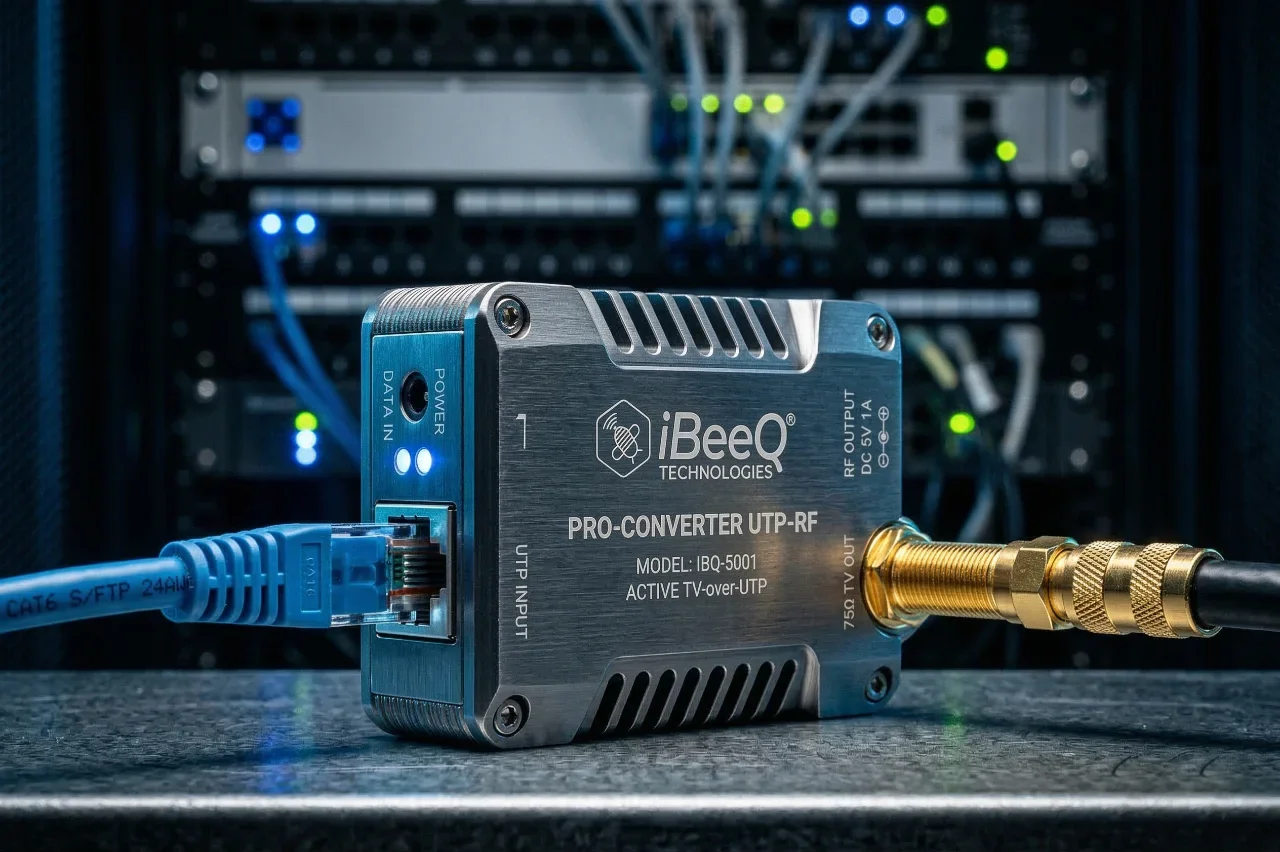
Passive RF-over-LAN Distribution: Maximum Efficiency, Minimum Capital Expenditure
The customized engineering strategy devised by iBeeQ centered on deploying a specialized passive RF-over-LAN distribution framework. This approach allows a property to stream uncompressed native digital TV frequencies over existing structural network lines without utilizing standard network IP data transit or requiring external electrical power supplies.
Core Elements of the Passive RF-over-LAN System:
- Leveraging Structural LAN Pathways: The deployment feeds raw radio frequency signals into structural Cat5e/6 cables, utilising balun transformers to route DVB-T/T2, DVB-C, or DVB-S2 frequencies across the unused copper pairs of a standard RJ45 drop.
- RF Balun Impedance Adapters: Specialized media converters match the 75-Ohm asymmetrical coaxial line to the 100-Ohm symmetrical UTP twisted-pair line at the headend, then reverse the transformation at the television side using a passive patch cable.
- Passive Network Components: The architecture bypasses local Ethernet switches entirely, using physical patch panels to create clean, uninterrupted point-to-point analog RF paths directly from the central server room to the guest room wall jacks.
- Signal Integrity at Distance: Thanks to precise high-gain amplification at the headend, the digital tuner inside the TVs receives flawless signal quality across long operational runs without macroblocking or pixelation.
- Rapid Scalability and Zero Construction: Installation takes place entirely inside the central server room rack and behind the TV frames, cutting deployment costs to a fraction of a standard IPTV refit.
A passive RF-over-LAN distribution framework represents a modern, highly cost-effective alternative for operational hotels, historic conversions, and medical properties that need to deliver native digital television without executing invasive wall demolition or high-cap hardware upgrades.
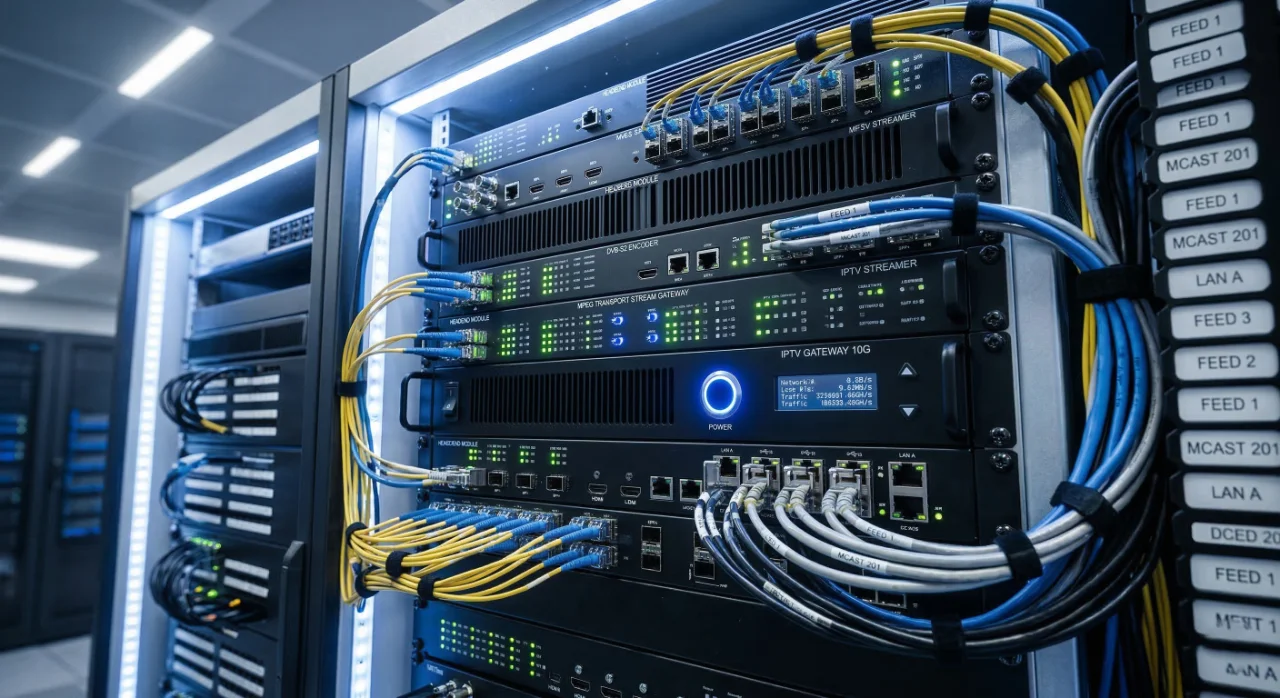
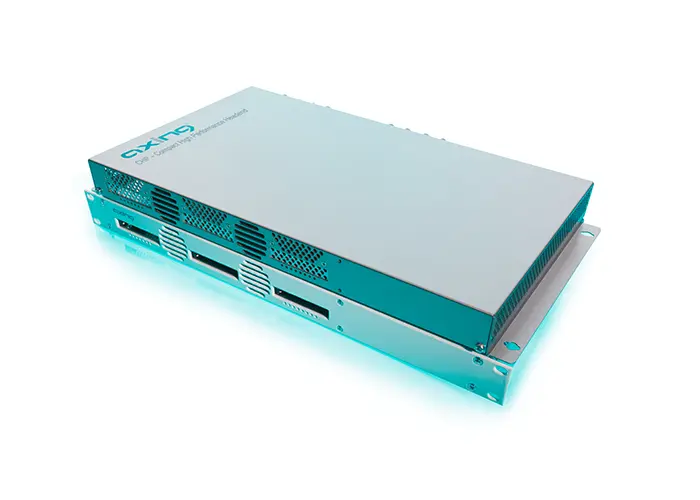
By leveraging this method, guests at The Viaduct gained instant access to pristine digital channels. To further elevate the property’s premium status, iBeeQ integrated an Axing enterprise IP-to-DVB headend station inside the master server rack. This allows the property to capture encrypted satellite signals, decrypt them centrally, and map foreign-language international channels natively onto the local UTP network lines.
Seamless Integration and Market Superiority
Executing this high-performance refit with zero structural masonry and absolute zero property downtime proved that innovative engineering can easily overcome rigid physical design limitations. By turning a critical technological bottleneck into a lightweight, budget-optimized asset, The Viaduct secured a clear market advantage.
“Thanks to the technical expertise and innovative engineering of the iBeeQ team, we completed a critical entertainment system upgrade without replacing our newly acquired hardware or penetrating the historic fabric of our building,” stated the General Manager of The Viaduct Prague. “Transmitting raw DVB-T digital signals cleanly across Cat5e/6 cables was a massive technical hurdle, but it was executed with exceptional precision. The passive RF-over-LAN system allowed us to deliver an extensive selection of international channels, which has received glowing feedback from our foreign guests, driving higher satisfaction and repeat bookings.”
FAQ — Frequently Asked Questions
What is the core difference between IPTV and an RF-over-LAN distribution system?
In a standard IPTV system, television channels are converted into digital IP data packets (multicast streams) that travel through network routers and switches, requiring active network management (IGMP) and smart TVs. An RF-over-LAN system completely bypasses your network switches. It uses the physical copper pairs inside a standard Cat5e/6 LAN cable as a direct substitute for a coaxial antenna wire, feeding raw digital television signals directly into the TV’s standard built-in tuner.
Does running television signals over LAN cables interfere with the guest Wi-Fi or internet speed?
No. Because the passive RF-over-LAN system uses dedicated, separate UTP cable drops or physical patch adjustments that bypass your active network hardware entirely, the television signal does not consume a single kilobit of your local network’s data bandwidth. Your guest Wi-Fi and corporate internet networks remain completely unburdened.
Can old Category 5e networks truly handle uncompressed digital TV distribution?
Yes. High-quality Category 5e and Category 6 structural UTP cables feature excellent internal copper shielding and twists that can easily propagate high-frequency digital signals over typical hotel lengths, provided the system uses high-quality 75-to-100 Ohm balun impedance matchers.
Does this passive deployment require the installation of set-top boxes behind guest TVs?
No. Because the signal arrives at the guest room wall jack in a native television format, a simple passive adapter cable plugs directly into the standard RF antenna input (Antenna In) of your existing TVs. Guests use the standard TV remote control without navigating complex external hardware boxes.
iBeeQ designs and installs hotel TV distribution systems across Europe — including RF-over-LAN, IPTV, and hybrid solutions tailored to your building’s existing infrastructure. Contact us for a free technical consultation.
Planning a hotel technology upgrade?
Our engineers have implemented hotel TV and WiFi systems across hundreds of properties in Europe. Let's talk about your project.
Contact us