
IPTV vs. OTT TV: The Complete Guide and Core Differences for Hotels
Understanding how modern internet protocol television and streaming services operate over hospitality networks, and how to combine them to maximize the guest experience.
Understanding how modern internet protocol television and streaming services operate over hospitality networks, and how to combine them to maximize the guest experience.
The evolution of high-speed internet infrastructure has fundamentally restructured the television industry, forcing commercial properties to focus on content personalization and user experience. Consequently, next-generation audiovisual technologies — specifically OTT TV and IPTV — have moved to the center of hospitality media strategies.
While both distribution frameworks transmit content using Internet Protocol (IP) networks, they differ fundamentally across technical topologies, network bandwidth guarantees, physical endpoints, and subscription parameters. Understanding these structural contrasts is essential for hotel owners choosing the optimal television framework for their property.
1. Defining the Technologies: What is OTT and IPTV?
OTT TV (Over-The-Top Television)
OTT is a delivery framework that streams uncompressed audiovisual media directly over the open, public internet. Guests access these services without requiring a local subscription to traditional cable or satellite systems. Platforms like Netflix, Disney+, YouTube, and Amazon Prime allow users to instantly consume content on-demand across multiple devices.
The primary operational advantage of OTT is unconstrained universal access. As long as a high-speed internet connection exists, guests can securely engage with their personal media catalogs anywhere on the property using smartphones, laptops, tablets, and hospitality Smart TVs.
IPTV (Internet Protocol Television)
IPTV is an enterprise technology that distributes television streams over a controlled, private, and managed IP local area network (LAN). Unlike traditional satellite setups or generic web streaming, true hospitality IPTV requires specialized local infrastructure, specifically a managed network backbone and an IP television headend station.
IPTV offers stable linear live television broadcasts alongside local video-on-demand (VOD) services and interactive room interfaces. These services are traditionally engineered and managed locally by specialized integrators as part of a structured hospitality infrastructure project.
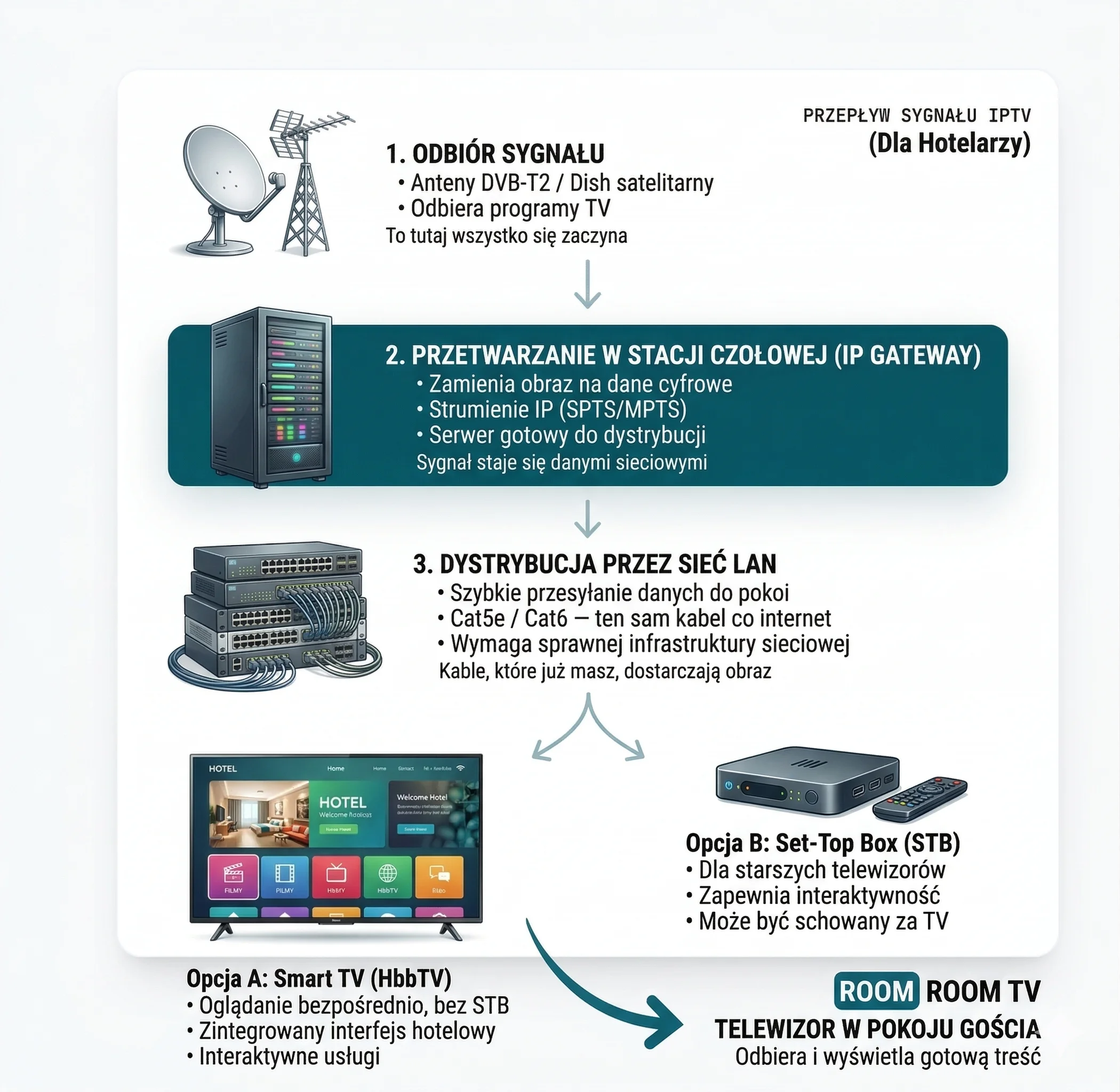
2. Technical Comparison: Topologies and Hardware Footprints
| Technical Criterion | Over-The-Top (OTT) Framework | Internet Protocol TV (IPTV) Framework |
|---|---|---|
| Data Delivery Pipeline | Broadcasted via the open public internet. Content scales dynamically over standard HTTP links. | Distributed via private, closed, and managed local networks (VLAN) with strict QoS guarantees. |
| Network Infrastructure | Requires zero specialized local headend hardware; entirely dependent on your raw internet connection. | Demands a physical hospitality IPTV headend (e.g., Lemco/Axing), managed edge switches, and IGMP configuration. |
| Endpoint Terminals | Multi-device unconstrained access: smartphones, personal laptops, tablets, or generic Smart TVs. | Requires specialized hospitality TVs with built-in IP tuners or dedicated IPTV set-top boxes (STB). |
| Bandwidth Allocation | Content consumption impacts your main internet pipeline. Streams can buffer if local Wi-Fi saturates. | Consumes zero public internet bandwidth for local live channels. Traffic is safely isolated inside a local voice/video VLAN. |
| Subscription & Flexibility | Highly flexible, user-managed app ecosystem. Guests typically authenticate using their personal profiles. | Structured long-term infrastructure asset. Custom channels are curated and locked centrally by hotel administration. |
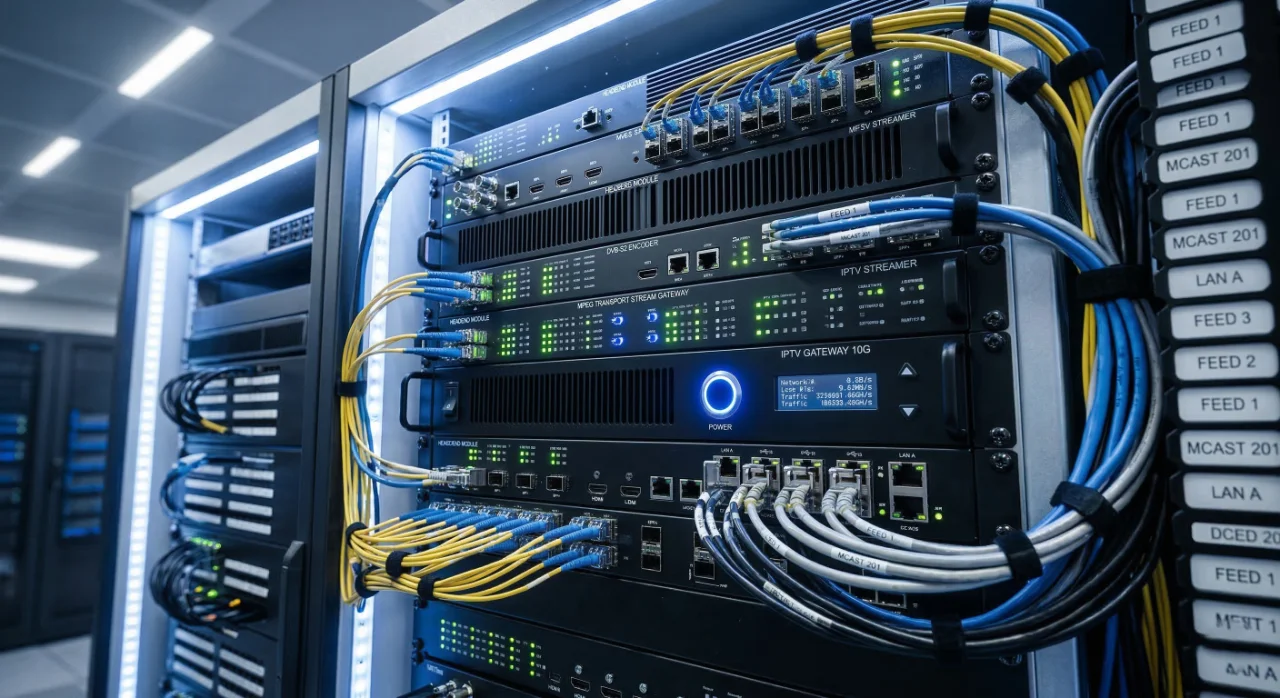
3. Combining Both Worlds: The Optimal Hybrid Architecture
For modern properties, choosing between IPTV and OTT is an outdated approach. High-end hotels implement a hybrid television architecture that leverages the architectural strengths of both platforms:
- IPTV for Uncompromising Reliability: Local live channels, international satellite news broadcasts, emergency hotel override alerts, and custom greeting interfaces run flawlessly over the local managed LAN using IPTV multicast, consuming zero external internet bandwidth.
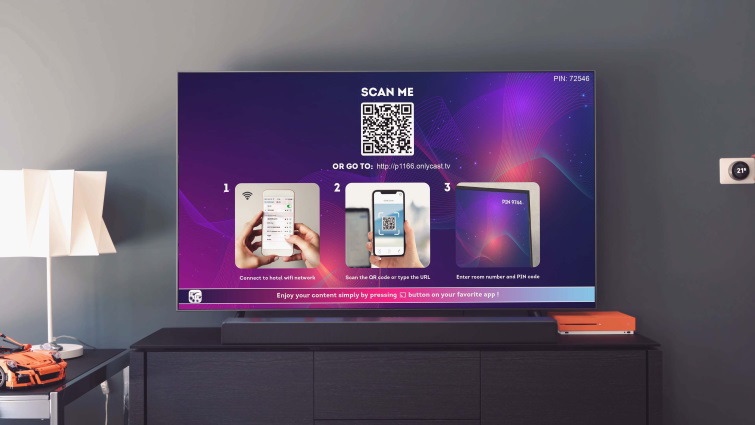
- OTT for Guest Personalization: Secure casting interfaces (such as Google Chromecast for Hotels or native Apple AirPlay) allow guests to cast their favorite streaming apps directly from their personal smartphones to the room display without inputting sensitive login passwords on the TV.
4. FAQ — Frequently Asked Questions
What is the most critical technical difference between IPTV and OTT?
IPTV runs inside a closed, managed network environment with guaranteed Quality of Service (QoS) parameters and IGMP Snooping, completely eliminating packet drops and buffering. OTT relies entirely on the public internet and local Wi-Fi stability, meaning heavy evening network surges can degrade stream quality if your wireless infrastructure isn’t future-proof.
Can a hotel safely deploy both systems simultaneously?
Yes. A hybrid framework is the industry gold standard. IPTV delivers crisp, instantaneous live TV channels without burdening your internet pipe, while an OTT casting layer gives guests access to their personal streaming subscriptions. Modern guest room management systems unify both technologies inside a single graphical brand interface.
What are the core local network requirements for hospitality IPTV?
IPTV distribution demands a dedicated video VLAN, edge switches supporting IGMP Snooping (v2/v3) to prevent network flooding, and a guaranteed local throughput profile of 8 to 20 Mbps per room for seamless 4K/HD streaming.
Is OTT a better choice than IPTV for a small boutique hotel?
For small properties under 20 rooms, an OTT-only casting setup can represent a highly cost-effective path with lower entry budgets. However, for properties exceeding 20 rooms, iBeeQ strongly recommends an IPTV layer to ensure unified, centralized channel management, localized emergency messaging, and robust infrastructure reliability.
iBeeQ designs and installs hotel TV distribution systems across Europe — including IPTV, OTT casting integration, and hybrid solutions tailored to your property’s existing infrastructure. Contact us for a free technical consultation.
Planning a hotel technology upgrade?
Our engineers have implemented hotel TV and WiFi systems across hundreds of properties in Europe. Let's talk about your project.
Contact us