
How Much Does Hotel Television Cost? The Full Picture
Buying hotel TVs is only the beginning. A complete hotel television system includes a headend, active network equipment, retransmission licensing, collecting society fees, and broadcast license obligations. Here is what to expect.
Television is no longer a selling point for hotel rooms — it is a baseline expectation. The cost of providing it, however, extends well beyond the purchase of screens.
A hotel that has just taken delivery of new in-room televisions often believes the largest expenditure is behind it. In practice, the hardware is only one part of the investment. A complete hotel television infrastructure carries a range of recurring costs that many operators discover only after the system is live.
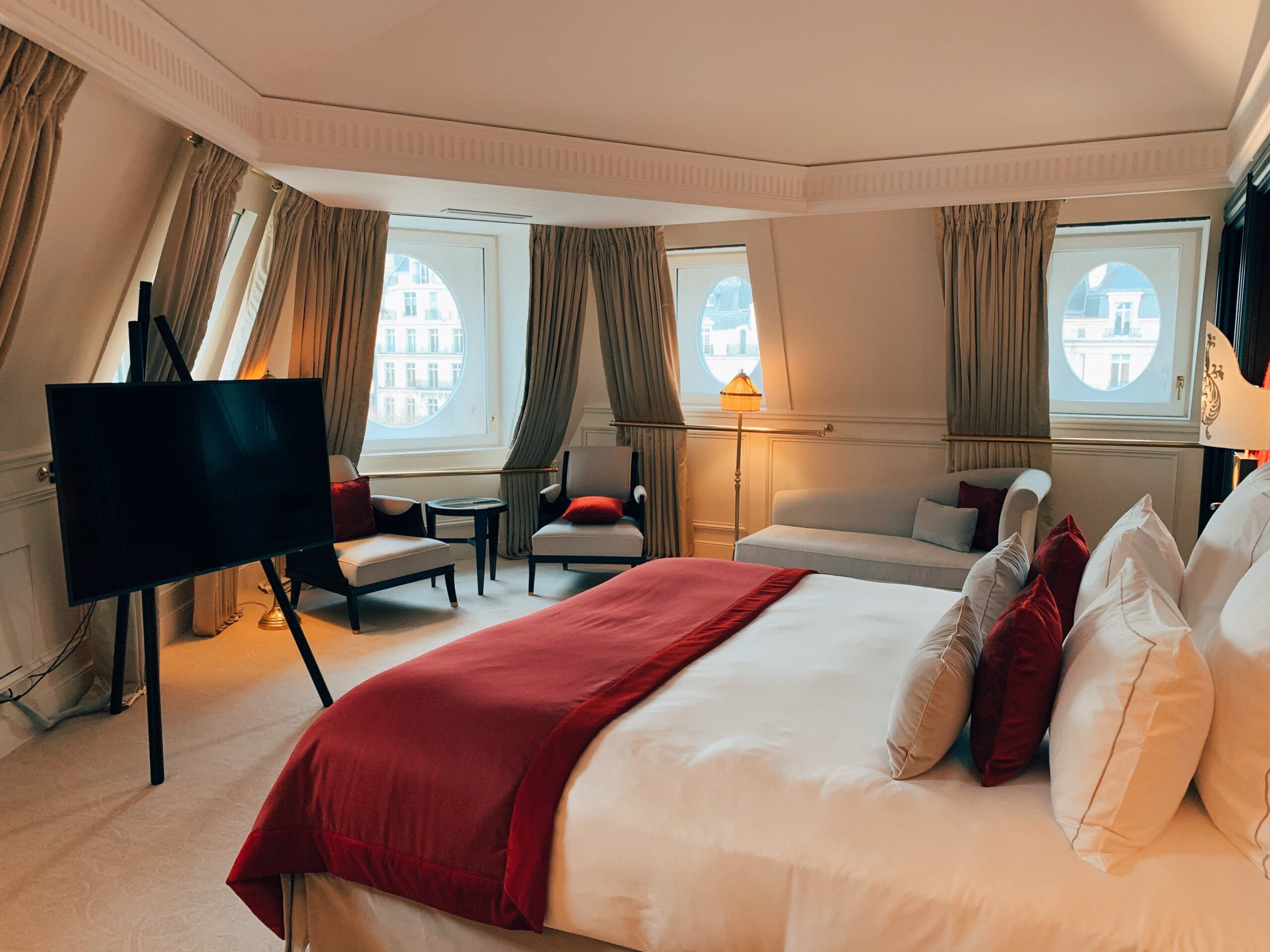
The Television Set Itself: Operating Costs
Calculating the electricity cost of a hotel television requires accounting for two distinct operating modes.
Standby mode is often underestimated. A standard hospitality television in standby draws approximately 0.3 W continuously. Over a full year, this amounts to roughly 2.6 kWh per set — under €1 at current European commercial electricity rates.
Some properties eliminate standby consumption entirely by cutting room power when the guest keycard is removed. This reduces electricity costs but creates two problems: the television boots slowly (20–60 seconds depending on model and CMS configuration), and it cannot receive remote management commands, automatic channel updates, or personalized welcome triggers from the PMS while unpowered. The trade-off is worth examining carefully.
Active viewing is the more significant cost. A 32-inch hospitality television in use draws approximately 46 W. At an assumed average of 5 hours of daily viewing and European commercial electricity rates around €0.28–0.32/kWh:
- Daily consumption:
0.23 kWh (€0.07) - Monthly:
7 kWh (€2.10) - Annual:
84.5 kWh (€25 per television)
For a 100-room property, annual electricity costs for room televisions alone approach €2,500 — before adding the headend and active network equipment.
The Headend: Compact vs. Modular
To receive foreign-language and premium satellite channels, hotels need a headend — a device that receives television signals from satellite and terrestrial broadcast sources and distributes them to room TVs, either over coaxial cable (DVB standard) or the hotel’s data network (IPTV).
Modern headends also pull channels from internet sources. As broadcast distribution continues shifting online, this capability becomes increasingly important.
Headends divide into two construction types, with materially different cost implications.
Compact headends
A compact headend is a closed-architecture device: fully equipped from the factory for the hotel’s required channel package, with no modular expansion required. This brings several advantages:
- Lower purchase price for equivalent channel capacity compared to modular systems
- Passive cooling — no fans, completely silent (0 dB), significantly lower energy draw
- Lower maintenance surface — fewer components and no module-to-module interconnects
A typical compact headend for a mid-size hotel draws approximately 75 W continuously. Annual electricity cost at European commercial rates: approximately €175–200 per year.
Modular headends
Modular systems allow operators to begin with a chassis and add input and output modules as requirements grow. The chassis itself often costs several thousand euros before any modules are added. Each module contains duplicated electronics, and the system requires forced-air cooling.
A fully equipped modular headend comparable in channel capacity to a compact unit draws approximately 280 W. Annual electricity cost: approximately €650–740 per year.
The difference — roughly €500/year — compounds significantly over a device lifetime typically estimated at 10 years: a cumulative saving of €4,000–5,000 by choosing a compact architecture from the outset.
A headend runs 24 hours a day, 365 days a year. The electricity cost of the wrong hardware choice accumulates silently for a decade.
Hidden vendor licensing costs
A less visible cost category: some headend manufacturers charge additional license fees for functionality beyond the base unit. Expanding the channel count, enabling remote management, or activating certain signal inputs may require purchasing a software license — sometimes at prices that are not disclosed upfront. Before selecting a headend, confirm whether the manufacturer applies licensing fees for expanded features. Several manufacturers in the professional broadcast equipment segment do not — and this should factor into the evaluation.
Active Network Equipment
Every hotel television network — whether coaxial or IP-based — includes active distribution components: building amplifiers, floor amplifiers, managed switches, or IP multicast routers. The number and specification of these components depend on the property’s scale and network topology.
These devices also run continuously. Their combined power draw contributes to operational electricity costs in proportion to the property’s size.
Retransmission Licensing
This is the cost category that most frequently surprises operators who are new to hotel television infrastructure.
Copyright law across EU member states establishes that television broadcasters hold exclusive rights to the retransmission of their content. Displaying broadcast channels on hotel room televisions — even channels classified as free-to-air — constitutes a retransmission requiring authorization from the rights holder. Some broadcasters grant this authorization without charge; most do not.
In parallel, collecting societies representing the rights of music and audiovisual content creators assess fees for the public performance of their members’ works. The societies involved and their fee structures vary by country — Germany operates through GEMA and GVL, France through SACEM, Czech Republic through OSA, Slovakia through SOZA. Fee levels are typically calculated on the basis of the number of rooms and the property’s commercial category.
These are ongoing costs, billed monthly or annually, that persist for the entire operational life of the system. They are not optional.
Broadcast License Fees
Separately from retransmission licensing, most European countries impose a broadcast reception license fee on operators of television receivers used commercially. The structure and amount vary by jurisdiction. In Germany, the Rundfunkbeitrag applies per facility on a tiered scale based on the number of rooms. Other countries operate similar schemes.
Unlike the collecting society fees described above, broadcast license obligations are a matter of regulatory compliance — failure to register devices and pay applicable fees exposes the property to substantial penalties.
What Can Actually Be Optimised
The licensing and regulatory cost categories are largely fixed. The areas where thoughtful procurement decisions produce measurable savings are:
- Headend selection — choosing a compact, energy-efficient architecture reduces electricity costs by €400–500 per year over modular alternatives.
- Channel package curation — viewership analytics from modern hospitality CMS platforms identify low-watched channels whose retransmission licenses can be cancelled without guest impact.
- Hardware longevity — selecting televisions with Android TV platforms and guaranteed update commitments extends the hardware replacement cycle.
FAQ — Frequently Asked Questions
Does every hotel have to pay retransmission licensing fees?
In the EU, yes — in principle. Hotels that distribute broadcast content to guest rooms are operating a retransmission service under copyright law. The practical enforcement and fee structures vary by country, but the legal obligation exists across all EU member states.
What is the annual electricity cost of a headend?
A compact headend draws approximately 75 W, costing around €175–200 per year in electricity at European commercial rates. A comparably equipped modular headend draws approximately 280 W, costing €650–740 per year. The compact alternative saves approximately €500 annually — over €5,000 across a 10-year operational lifetime.
Are broadcast license fees mandatory for hotels?
Yes. In most European jurisdictions, hotels are required to register and pay applicable broadcast reception fees for each television in operation. The specific fee structure varies by country. Non-compliance can result in significant retroactive penalties.
What are collecting society fees?
Collecting societies (GEMA, SACEM, OSA, SOZA, and equivalents) represent composers, performers, and audiovisual rights holders. Hotels playing music or broadcasting audiovisual content in guest rooms must pay fees to the applicable collecting societies. These are typically assessed annually based on room count and property classification.
How can a hotel reduce headend costs?
Choosing an energy-efficient compact headend over a modular alternative is the single largest lever. Reviewing the channel package against actual viewership data allows operators to eliminate low-use retransmission licenses. Ensuring the headend vendor does not apply expansion license fees avoids unexpected future costs.
Can the headend have hidden costs?
Yes. Some manufacturers charge license fees for additional channels, remote management access, or firmware updates beyond the initial purchase. Request a full disclosure of current and projected license fees from any headend vendor before committing to a purchase.
iBeeQ designs, supplies, and installs complete hotel television infrastructure across Europe — headend selection, network design, cabling, CMS configuration, and licensing guidance. Contact us for a free technical consultation.
Planning a hotel technology upgrade?
Our engineers have implemented hotel TV and WiFi systems across hundreds of properties in Europe. Let's talk about your project.
Contact us