
Hotel WiFi Upgrade: How a 21-Room Property Achieved Full Coverage — Case Study
A three-star hotel with 21 rooms, a banquet hall for 200 guests, outdoor areas, and a mobile POS terminal on the town square: how TP-Link Omada SDN solved WiFi, CCTV, and VPN in one unified implementation.
When a hotel’s WiFi generates guest complaints, the problem is rarely just weak signal. It is usually a combination of coverage gaps, network congestion under load, absent network segmentation, and no mechanism for managing the infrastructure remotely. This case study documents how a 21-room hotel resolved all four simultaneously — along with outdoor coverage, CCTV infrastructure, and VPN access for a POS terminal located on the town square.
The Property
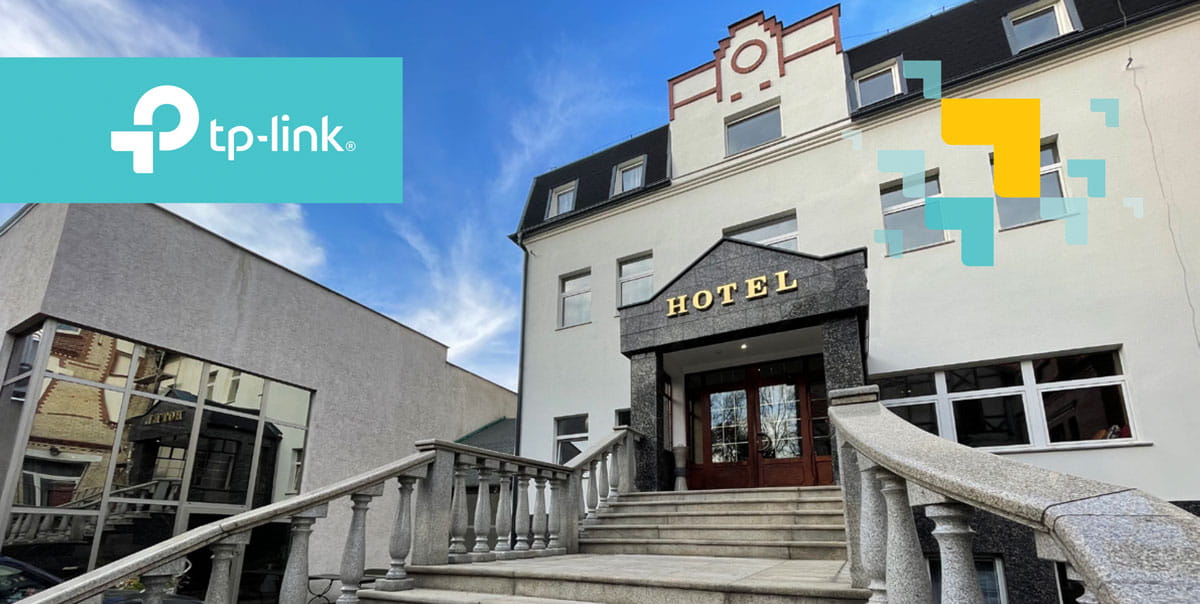
Hotel Park is a three-star hotel situated in a quiet part of Świdnica, Poland, adjacent to a park. The property has 21 rooms across several categories — economy, standard, and comfortable rooms including apartments — a conference room for approximately 35 persons, and a conference-banquet hall accommodating 200 guests.
The combination of room guests, large-format events, and operational systems (point of sale, payment terminals, administrative computers) placed significant and varied demands on the network infrastructure.
The Challenge
The brief for the project covered several requirements:
Full coverage throughout the property — all rooms, corridors, and the conference spaces needed stable wireless connectivity.
POS and payment terminal support — the hotel’s point-of-sale system and payment terminals needed reliable network connectivity as operational-critical systems.
Outdoor WiFi — guests needed coverage in the parking area outside the building.
CCTV infrastructure — the implementation needed to provide network connectivity and PoE power for the camera system.
Complete guest/staff network separation — the guest network had to be entirely isolated from the staff and operational network. A shared network creates both security exposure and congestion when guest devices saturate available bandwidth during events.
Remote VPN access — hotel management needed secure remote access to the internal network. A mobile POS terminal operating on the town square also needed to connect back to the hotel’s internal POS system.
Guest authentication via captive portal — guests should authenticate through a welcome page on first connection.
The Solution: TP-Link Omada SDN
The implementation team selected the complete TP-Link Omada SDN system. The Omada platform integrates routers, switches, and access points under centralised control, managed either from the on-site hardware controller or remotely from any location via cloud.
Core Infrastructure
Router: TP-Link ER7206 — the gateway handling internet access, routing between VLANs, VPN tunnelling, and traffic policy enforcement.
Indoor access points: 13× EAP265 HD — deployed throughout the building. The EAP265 HD is designed for high-traffic environments and supports several hundred simultaneous client connections per unit. This ensures stable network performance during events such as weddings or conferences where guest density is highest.
“We chose TP-Link because the solution allows creating multiple isolated SSIDs and associating them with VLANs. Additionally, the solution had to enable remote access via VPN for hotel management and for the mobile POS terminal on the town square. A captive portal authentication requirement was also specified by the client,” explains Piotr Morawski, Technical Manager at iBeeQ.
Outdoor access points: 4× EAP225-Outdoor — installed on the exterior of the building. The EAP225-Outdoor carries an IP65 weatherproof rating and is rated for operation in low temperatures. Mesh technology eliminates the need for additional outdoor cabling: each outdoor unit operates wirelessly paired with the nearest indoor network point.
“We chose the EAP225-Outdoor primarily for its Mesh support, which enables wireless connections between access points. This allowed us to avoid additional cabling, which in this case was critical. Each EAP225-Outdoor unit operates in tandem with a switch located directly adjacent to the CCTV cameras. This arrangement allowed us to simultaneously power the access points and cameras and connect both to the rest of the network,” adds Piotr Morawski.
Switching Infrastructure
The main server room houses a TL-SG3428X 24-port managed switch with 10G SFP+ uplinks. Four TL-SG2008P 8-port PoE+ switches — distributed across different building sections — power the indoor EAP265 HD access points via PoE. CCTV connectivity is handled by a TL-SG1005P 5-port PoE switch and a TL-SG2210P 8-port PoE+ switch. Ten TL-SM311LS MiniGBIC single-mode modules handle fibre interconnection between switches.
Centralised Management: OC300 Hardware Controller
The Omada OC300 hardware controller unifies the entire Omada SDN estate under a single interface — access points, managed switches, PoE switches, and the router. From this single dashboard the implementation team configured:
- Real-time traffic statistics and visualisation tools
- VLAN segmentation separating guest, staff, IoT, and CCTV network segments
- Captive portal guest authentication with session management
- VPN configuration for remote management access
- Firmware update scheduling across all devices
- Cloud access for configuration changes from any location
The Results
Stable network throughout the building — guests and staff gained wireless coverage in all rooms, corridors, and common spaces without dead zones.
Event capacity — the EAP265 HD access points handle the intensive traffic generated during large events without degradation. The network is sized for maximum occupancy, not average load.
POS and payment terminals — both systems operate smoothly across the isolated operational VLAN with no reported interruptions.
Outdoor coverage — guests have WiFi access in the parking area through the EAP225-Outdoor units. The Mesh architecture automatically reroutes traffic if any node loses connectivity.
CCTV — the camera system operates within its dedicated network segment, powered and connected through the outdoor PoE switch arrangement.
VPN — hotel management can access internal network resources remotely. The mobile POS terminal on the town square maintains full connectivity to the hotel’s internal POS system.
“Thanks to this implementation we gained new possibilities for remote work — the VPN connection allows us to work from anywhere as if we were physically inside the hotel’s internal network. The mobile point of sale on the town square also gained full integration with the internal hotel POS system. Most importantly, the WiFi for our guests finally works the way we wanted it to. Our clients no longer report issues with WiFi — which I consider the best possible recommendation.”
— Kamila Suchorzewska, Director, Hotel Park Świdnica
Implementation Summary
| Component | Specification | Quantity |
|---|---|---|
| Router | TP-Link ER7206 | 1 |
| Indoor AP | EAP265 HD | 13 |
| Outdoor AP | EAP225-Outdoor (IP65, Mesh) | 4 |
| Controller | OC300 (hardware) | 1 |
| Core switch | TL-SG3428X (24-port, 10G SFP+) | 1 |
| PoE+ switch (APs) | TL-SG2008P (8-port) | 4 |
| PoE switch (CCTV) | TL-SG1005P (5-port) | 1 |
| PoE+ switch (CCTV) | TL-SG2210P (8-port) | 1 |
| SFP+ modules | TL-SM311LS (single-mode) | 10 |
FAQ
What did the WiFi upgrade at Hotel Park involve?
Complete replacement of the existing wireless infrastructure with an enterprise-grade TP-Link Omada SDN solution: professional access points, VLAN segmentation, guest captive portal authentication, VPN, and centralised management via a hardware controller.
What problems did the hotel have before the upgrade?
Dead zones in rooms and corridors, network congestion during peak occupancy, no separation between the guest network and hotel operational systems, and no remote management capability.
How long does a hotel WiFi upgrade take?
A project of this scope in an operating hotel typically takes several working days. iBeeQ plans work to allow the hotel to continue hosting guests without interruption or visible disruption.
What were the results of the upgrade?
A stable network without dead zones, full VLAN traffic segmentation (guests / staff / IoT / CCTV), VPN for remote management, outdoor coverage, and integrated CCTV — all managed from a single dashboard with no requirement for on-site IT support.
Does iBeeQ carry out WiFi upgrades in other hotels?
Yes. iBeeQ implements WiFi projects in hotels of all sizes — from small boutique properties to large hotel chains. Every project begins with an on-site audit and professional signal coverage measurements.
iBeeQ designs, installs, and optimises hotel WiFi networks across Europe — access point placement surveys, VLAN configuration, PoE infrastructure, and cloud fleet monitoring. Contact us for a free technical consultation.
Planning a hotel technology upgrade?
Our engineers have implemented hotel TV and WiFi systems across hundreds of properties in Europe. Let's talk about your project.
Contact us